WORKS AVAILABLE FOR SALE
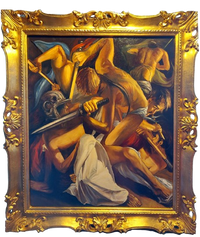
TITLE: CLASHES BETWEEN ARMED MEN
ARTIST: MASSIMO NESTI
TECHNIQUE: OIL ON CANVAS
SIZE: 60 × 70 CM, WITH FRAME
YEAR: 2016
PRICE: €3,190.00
(Shipping not included)
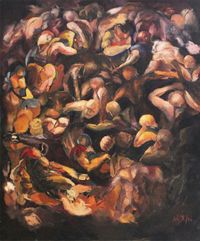
TITLE: COMBAT
ARTIST: MASSIMO NESTI
TECHNIQUE: OIL ON CANVAS
SIZE: 80 x 120 CM
YEAR: 2002
PRICE: €3,850,00
(Shipping not included)

TITLE: IN THE HEART OF THE FIGHT
ARTIST: MASSIMO NESTI
TECHNIQUE: OIL ON CANVAS
SIZE: 50 x 50 CM
YEAR: 2013
PRICE: €1,430.00
(Shipping not included)

TITLE: THE IGNAVI
ARTIST: MASSIMO NESTI
TECHNIQUE: OIL ON CANVAS
SIZE: 90 x 90 CM
YEAR: 2002
PRICE: €3,300.00
(Shipping not included)

TITLE: THE ORIGINAL MAN
ARTIST: MASSIMO NESTI
TECHNIQUE: OIL ON CANVAS
SIZE: 83.5 x 62 CM, WITH GLASS AND FRAME
YEAR: 2002
PRICE: €2,530.00
(Shipping not included)
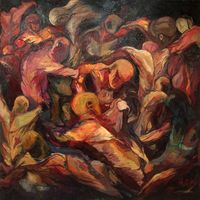
TITLE: FIGHT I
ARTIST: MASSIMO NESTI
TECHNIQUE: OIL ON CANVAS
SIZE: 80 x 80 CM
YEAR: 2002
PRICE: €3,080.00
(Shipping not included)

TITLE: LUCHA II
ARTIST: MASSIMO NESTI
TECHNIQUE: OIL ON CANVAS
SIZE: 80 x 80 CM
YEAR: 2002
PRICE: €3,080.00
(Shipping not included)

TITLE: MAGMA
ARTIST: MASSIMO NESTI
TECHNIQUE: OIL ON CANVAS
SIZE: 50 x 70 CM
YEAR: 2002
PRICE: €2,750.00
(Shipping not included)
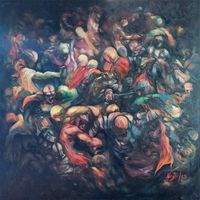
TITLE: BATTLE SCENE II
ARTIST: MASSIMO NESTI
TECHNIQUE: OIL ON CANVAS
SIZE: 100 x 100 CM
YEAR: 2023
PRICE: €3,520.00
(Shipping not included)
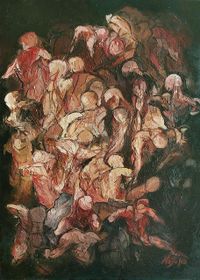
TITLE: COLLISION
ARTIST: MASSIMO NESTI
TECHNIQUE: OIL ON CANVAS
SIZE: 50 x 70 CM
YEAR: 2003
PRICE: €1,650.00
( Shipping not included )

TITLE: WATER, WORK I
ARTIST: MASSIMO NESTI
TECHNIQUE: OIL ON CANVAS
SIZE: 120 x 100 CM
YEAR: 2023
PRICE: €4,290.00
(Shipping not included)
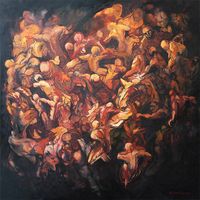
TITLE: THE CIRCLE OF DANTEARTIST: MASSIMO NESTITECHNIQUE: OIL ON CANVASDIMENSIONS: 100 x 100 CMYEAR: 2014PRICE: €4,719.00(Shipping not included)
Winner of the International Archaist Prize, Tarquinia (VT), September 2021, and awarded by the press at the Riflessi d'Arte Exhibition, Martina Franca (TA), October 19, 2022.
.jpg/picture-200?_=19cf13a646d)






EXHIBITIONS by MASSIMO NESTI

Massimo Nesti — Biographical Profile
Massimo Nesti (Milan, 1967) is an Italian painter, illustrator and educator whose work lies at the intersection of classical tradition and contemporary expression.
He studied at the Liceo Artistico Statale II in Milan and graduated in Painting from the Accademia di Belle Arti di Brera in 1991, presenting a thesis on Ennio Morlotti and Italian Informal Art. Alongside his artistic practice, he has developed an extensive career as a teacher of Visual and Graphic Arts, illustrator, cartoonist and trainer.
Since 2010, he has served as Director of the NV Artistic Laboratory in Senigallia (AN), where he offers courses in drawing, painting techniques, illustration, comics, animation drawing, art history, visual perception and colour theory. Through this institution, he actively promotes art education and cultural training in collaboration with Cristina Verdelli.
A highly regarded artist, Nesti has exhibited in numerous prestigious venues in Italy and abroad, including Tokyo, Strasbourg, Innsbruck, Milan, Rome, Verona, Viterbo and Tarquinia. His works are included in the General Catalogue of the Italian Art Encyclopaedia, which documents major Italian artists of the twentieth century.
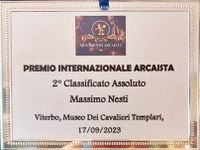
He was the Overall Winner of the Arcaista International Prize (2021) and was appointed Honorary Academician of Italian Art ad honoris causa by the Rector of the Archaist Academy, Prof. Antonio Santoro. In 2023 he received second place at the Arcaista International Award with the work Terra Opera I, and in 2025 he was granted an Honourable Mention of Italian Art with permanent ratification within the ideological selection of the Archaist Movement.
Art critic Giorgio Grasso describes Nesti’s poetics as a return to traditional art, evoking the legacy of the Italian Renaissance and Caravaggio. His use of light functions both physically and intellectually, illuminating not only the artwork but also the viewer’s consciousness.
Nesti’s artistic research explores the relationship between humanity, nature and historical memory. His early works show a strong Caravaggesque influence, with warm palettes and dramatic contrasts of light, while his later production introduces dynamic geometric structures and expressive colour fields. His compositions often depict figures in struggle, transformation and rebirth, symbolising the cyclical bond between humankind and the natural elements — water, fire, rock and earth.
Beyond painting, he has collaborated as an illustrator and graphic designer with publishing houses, cultural institutions and animation studios, including work on animated films featuring the character Corto Maltese directed by Pascal Morelli.
In 2024 he published the instructional book “I Segreti nel Disegno con le Forme” (Secrets in Drawing with Shapes), a practical six-step method for understanding the anatomy of the head through simplified structural forms.
He lives and works in Senigallia (Ancona), where he continues to promote artistic culture, education and visual communication.
REVIEW
The art of Massimo Nesti represents the rediscovery of a cultural and artistic tradition rooted in the Italian art scene of the first half of the 17th century (Seicento).
In the academic sphere, in addition to a detailed study of the figure, the artist examines color and texture in informal landscapes.
Through his study of nature, he achieves a perception of reality imbued with emotion and feeling.
In later works, the artist readily reproduces the nuances and colors of the emerging realism of those years, where a contrast can be observed between the academicism of Carracci and the realism of Caravaggio.
In fact, his early works are strongly influenced by the latter and develop the style, the use of warm tones, and volumes that emerge through radiant beams of light. The value of these roots is evident in this initial phase, enriching and sustaining an artistic period that spans from the Early Renaissance to the Caravaggio revolution. Here, the artist immerses himself with passion and dedication, studying the art of Merisi and always keeping in mind the Renaissance tradition, in which humankind rediscovered its own dignity and a particular way of thinking, independent of theology. A Renaissance that influenced all his abilities.
Massimo Nesti's artistic exploration communicates, in a simple way, the inner disquiet perceived in a society devoted to technology and modernity.
While characterized by elements that evoke speed and movement, such as lines of force, ellipses, and vortices, the artist's artistic expression deviates substantially from the Futurist concept of speed.
Futurism, in contrast to traditional culture, posed the challenge of a complete and radical renewal, both in the arts and in social and political life.
Such change was considered inevitable and was directly linked to the new reality of industrial civilization, dominated by machines and the myths of speed and progress.
In this artist's work, there is no direct parallel with the Futurist movement's ideology; to establish a framework, he uses geometric elements such as ellipses and curves that lend a dynamic structure to the composition.
The difference lies in the fact that, in this case, humanity is presented in a continuous struggle with itself and with others.
This is a recurring image that conveys a reality, both present and past, of fear, fueled by violence.
In these works, embryonic evolution replaces the cold, Futurist machine and is proposed as a transition, where humanity moves from a formal stage to a principle of nature.
The recurrence of phenomena closely linked to humanity and nature is increasingly reflected in the works. The battle scenes, which depict suffering, cruelty, and the current state of affairs, are a means to achieve better living conditions.
The concept of reality is analyzed here within the context of parallel historical moments. The various battle scenes invite reflection on the epic moments of ancient heroes and, at the same time, on current realities and events, with multitudes of protagonists immersed in violent and turbulent phases.
The paintings possess their own narrative, their own story, both ancient and contemporary; humankind is depicted in motion, evolving, alternating between struggle and defense; it yearns to transform itself by transporting itself to different and better realities, where it no longer needs to avoid its fellow human beings, but rather finds the spirit to unite with them and become one with them.
In their movements, the figures undergo a natural transformation; their defining characteristic becomes a cycle: the union between humankind and nature becomes dominant.
After their phase of struggle, the individual prepares to integrate with natural elements such as water, fire, rock, and earth.
The artist's exploration takes a significant step: Caravaggio's colors transform into expressionistic tones; vibrant colors stand out against the natural elements and communicate humanity's union with them.
The embryonic forms mutate and become water and rock. The figure encounters nature, absorbs its form and spirit, acquires its properties, reaching the end and the beginning of a cycle where the figure dies and is reborn through matter.
Awards:
Fano (PS) – Rocca Malatestiana; winner of first prize in the national competition organized by Val Cesano Arte, July 2013.
Listed in the Encyclopedia of Italian Art among the greatest Italian artists of the 20th century.
Overall winner of the International Arcaist Award in September 2021 and named an Honorary Academician of Italian Art by the Rector of the Arcaist Academy, Professor Antonio Santoro.
Martina Franca (TE), Palazzo Ducale, 12th edition of the Festival dell'Immagine. Winner of the Press Award with the work "Girone Dantesco," for the power of the message expressed with a striking painting technique.
Viterbo, Museum of the Knights Templar, September 17, 2023; Second place overall in the International Arcaist Award with the work "Terra Opera I." Awarded by the Rector, Dr. Antonio Santoro, with an honorable mention for Italian Art and permanent recognition in the ideological selection of the Archaist Movement.